Introduction
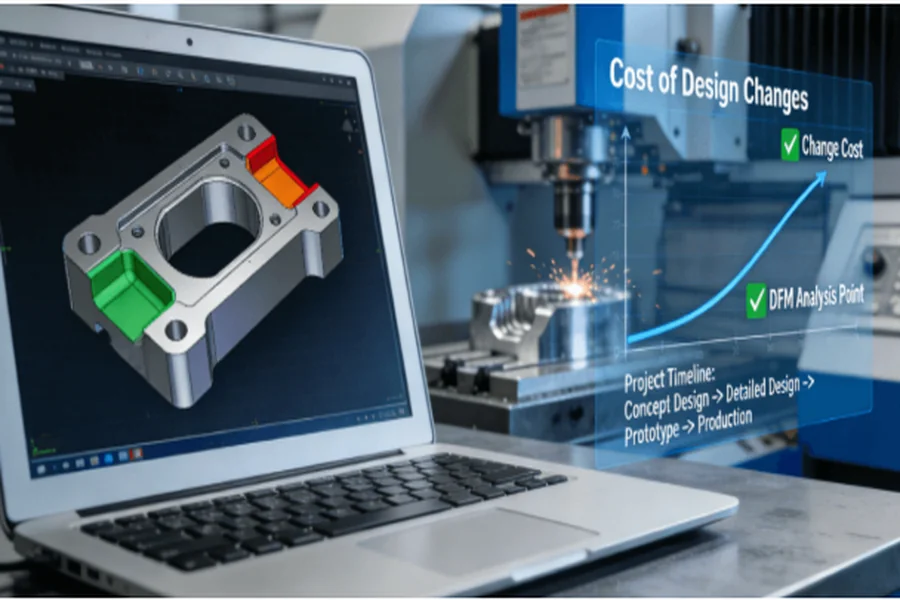
In the high-stakes world of product development, a critical gap often emerges between a designer’s vision and manufacturing reality. Many product designers, focused on form and function, neglect manufacturing feasibility in the early stages. This disconnect leads to costly redesigns, budget overruns, and frustrating launch delays during mass production. The root of the problem is profound: an estimated 75% of a product’s total lifecycle cost is determined during the design phase. Yet, traditional development workflows only surface these costly manufacturability issues during prototyping or trial production, when changes are exponentially more expensive.
This article introduces a transformative, proactive solution: a data-driven Design for Manufacturing (DFM) methodology. By systematically integrating manufacturing constraints and expert knowledge at the very beginning of the design process, designers can systematically optimize for cost, efficiency, and quality. The following sections will detail the core principles of DFM, outline a practical implementation process, and demonstrate its powerful synergy with modern manufacturing processes like CNC machining, empowering designers to de-risk projects from the source.
What is Design for Manufacturing and How Does It Transform Product Development?
Design for Manufacturing (DFM) is a systematic engineering methodology focused on designing products for ease of manufacture. It transcends a simple checklist, evolving from theory into a data-driven practice that harmonizes creative design intent with the pragmatic realities of the production floor. The core objective is to simplify product structures, select optimal materials and processes, and define intelligent tolerances — all to minimize production complexity and cost without compromising performance.
1. Defining the Pillars of Modern DFM
Modern DFM rests on several key pillars: part consolidation to reduce assembly steps, strategic material and process selection for cost and performance, and intelligent tolerance specification. It is a collaborative philosophy that bridges the gap between design and production teams. When executed well, studies show DFM can reduce production costs by 15-30%, transforming product development from a linear, error-prone sequence into a concurrent, optimized system. This systematic approach is highly compatible with standardized quality frameworks, such as those outlined in the ISO 9001 standard for quality management systems, which emphasize process control and continuous improvement.
2. The Shift from Corrective to Preventive Action
Historically, manufacturing issues were addressed reactively — after a design was finalized. DFM represents a paradigm shift to preventive, upfront optimization. It involves virtual simulations, knowledge-based rules, and cross-functional reviews to identify and eliminate potential production hurdles — such as impossible-to-machine features or overly tight tolerances — long before any physical prototype is created. This proactive stance is the key to unlocking the significant cost and time savings promised by the methodology.
3. The Economic Imperative of Early Integration
The financial impact of DFM is non-linear. A design change that costs $100 at the concept stage can balloon to $10,000 during tooling and over $1,000,000 after production has begun. By front-loading the design process with manufacturing intelligence, companies avoid these exorbitant late-stage changes. This makes DFM not merely a “nice-to-have” but a critical economic imperative for any business serious about profitability and speed-to-market.
Why is Early DFM Integration Critical for Avoiding Costly Redesigns in CNC Machining?
CNC machining, while exceptionally versatile, has its own set of constraints and cost drivers. Integrating DFM principles at the earliest stages of a CNC project is the most effective strategy to prevent expensive and time-consuming redesigns. The synergy between DFM and CNC lies in designing parts that are not only functional but also inherently efficient to machine.
1. Preventing “Un-machinable” Features and Tooling Conflicts
A common and costly issue arises when designers specify features that are physically impossible or prohibitively expensive to machine. This includes designing deep cavities with small entry points, specifying internal sharp corners, or creating geometries that cause toolholder collision. Early DFM analysis, often using virtual simulation software, identifies these issues. For example, a medical device company redesigned a valve body by slightly adjusting internal wall angles and radii, which allowed for standard tooling and reduced machining time by 35%, directly translating to lower costs.
2. Optimizing for Machining Efficiency and Tool Life
Every design decision influences machining time. Factors like wall thickness, feature depth, and the selection of standard vs. custom tool sizes have a dramatic impact. DFM guides designers toward choices that enable faster material removal, such as using larger, more stable cutters and avoiding excessively deep pockets that require slow, peck-drilling cycles. This optimization directly reduces machine time, extends tool life, and lowers the per-part cost. A deep understanding of these principles, as detailed in resources like the guide on design for manufacturing, provides a crucial framework for designers.
H3: 3. Ensuring Precision Through Intelligent Tolerance Design
Over-specifying tolerances is a major source of CNC machining cost inflation. A tolerance of ±0.025mm can be multiple times more expensive to hold than ±0.075mm. DFM employs the principles of Geometric Dimensioning and Tolerancing (GD&T) as defined in standards like ASME Y14.5. This allows designers to apply tight tolerances only where they are functionally critical (e.g., bearing surfaces) and use standard, more economical tolerances elsewhere. This disciplined approach prevents unnecessary precision machining and the rework it often entails.
How Can DFM Principles like Simplification and Standardization Enhance Manufacturing Efficiency?
At its heart, DFM is governed by timeless principles that streamline production. Simplification and standardization are two of the most powerful, driving efficiency across every stage of manufacturing, from sourcing to assembly.
- The Power of Part Consolidation and Simplification: The most effective way to reduce cost and improve reliability is to reduce the number of parts. Part consolidation involves redesigning an assembly of several components into a single, more complex monolithic part. While this part may be more challenging to machine, it eliminates fasteners, simplifies inventory, reduces assembly labor, and minimizes potential failure points. For instance, converting a multi-part bracket assembly into one CNC-machined aluminum component can cut assembly time by 30-50% and improve structural integrity.
- Leveraging Standardization for Speed and Cost Reduction: DFM encourages the use of standardized features: common drill sizes, uniform fillet radii, and preferred thread types. This allows manufacturers to use existing, proven tooling rather than sourcing or manufacturing custom tools for every job. Standardization speeds up the CNC programming process, reduces setup times, and lowers overall tooling inventory costs. It creates a predictable, repeatable manufacturing process that is easier to scale and quality control, aligning perfectly with the process-oriented approach mandated by quality management systems like ISO 9001.
- Designing for Efficient Assembly (DFA): A key subset of DFM is Design for Assembly (DFA). This principle focuses on making products easy and mistake-proof to put together. Techniques include designing parts that can only be assembled in the correct orientation, using self-locating features, and minimizing the number and types of fasteners. A product designed with DFA in mind requires less skilled labor for assembly, has higher first-pass yield rates, and results in lower warranty claims due to assembly errors.
What Role Does Tolerance Design Play in DFM for High-Precision Components?
In industries like aerospace, medical devices, and optics, precision is non-negotiable. However, precision must be applied strategically. Tolerance design within a DFM framework is the art of defining the minimum acceptable variation that still guarantees part function, thereby avoiding the high cost of unnecessary perfection.
1. Understanding the Cost-Precision Curve
The relationship between tolerance and cost is exponential, not linear. Holding a tolerance of ±0.005mm may cost ten times more than holding ±0.05mm. It requires slower machining speeds, more frequent tool changes, specialized measuring equipment, and a higher likelihood of scrap. A DFM-informed approach involves collaborating with manufacturing engineers to understand this curve and specify tolerances that achieve the required functional performance at the lowest possible cost.
2. Applying GD&T for Functional Control
Rather than relying solely on traditional plus/minus tolerancing, DFM utilizes Geometric Dimensioning and Tolerancing (GD&T). This symbolic language, standardized in ASME Y14.5, allows designers to control the form, orientation, and location of features in a way that reflects how the part actually functions in an assembly. For example, using a position tolerance on a set of mounting holes is more functional and often more manufacturable than applying extremely tight linear dimensions to each hole. This leads to parts that fit together better and are less likely to be rejected for non-critical deviations.
3. Statistical Process Control (SPC) and Capability Index (Cpk)
For high-volume production, DFM links tolerance design to process capability. The goal is to set tolerances that the manufacturing process can consistently achieve. This is measured by the Process Capability Index (Cpk). A robust DFM process will aim for a design where the specified tolerance is wide enough to achieve a Cpk of 1.33 or higher, indicating the production process is well-controlled and capable of producing virtually all parts within specification, minimizing scrap and inspection costs.
How Does DFM Collaborate with Quality Control Systems to Ensure Product Reliability?
DFM and Quality Control (QC) are not separate functions; they are integrated components of a robust product development system. DFM builds quality into the product from the start, while QC systems verify and maintain that quality throughout production.
- DFM as Proactive Risk Mitigation: Traditional QC is often reactive, inspecting finished parts for defects. DFM flips this script by being inherently proactive. It identifies potential failure modes — such as stress concentrations, potential for cosmetic defects, or assembly difficulties — during the design phase. By addressing these risks upfront, DFM dramatically reduces the number of defects that QC systems need to catch later, leading to higher first-article success rates, often jumping from 85% to over 98%.
- Integration with Certified Quality Management Systems (QMS): The methodology of DFM aligns seamlessly with international quality standards. A QMS certified to ISO 9001 provides the framework for documenting DFM guidelines, conducting design reviews, and managing engineering changes. It ensures that DFM is not an ad-hoc activity but a disciplined, repeatable process. For automotive or aerospace projects, standards like IATF 16949 and AS9100D further embed DFM principles into industry-specific requirements for risk management, traceability, and product safety, ensuring reliability from the drawing board to the end user.
- Creating a Digital Thread for Traceability: In a modern, data-driven environment, DFM decisions are captured digitally. This creates a “digital thread” that links the design intent (with its DFM-optimized tolerances and features) directly to the machining instructions (CAM) and finally to the inspection reports (CMM data). This traceability allows for closed-loop feedback: if a particular feature consistently measures at the edge of tolerance, the DFM can be reviewed and the design updated for future revisions, fostering a culture of continuous improvement.
When Should Businesses Consider Outsourcing DFM Analysis to a Specialized Service Supplier?
While building internal DFM expertise is valuable, there are clear scenarios where partnering with a specialized DFM service provider offers superior speed, cost-effectiveness, and results. The decision often hinges on resource availability, project complexity, and strategic focus.
1. Scenario: Lack of In-House Manufacturing Expertise
Many companies, especially startups or firms focused on design and marketing, may not have deep, cross-process manufacturing knowledge on staff. An experienced DFM service supplier brings immediate, broad-based expertise in materials, processes (from injection molding to CNC to additive manufacturing), and cost drivers. They act as an extension of your engineering team, providing objective, manufacturability-focused feedback that pure designers might miss.
2. Scenario: High-Complexity or High-Risk Projects
For projects involving advanced materials (e.g., titanium, PEEK), intricate geometries, or stringent regulatory requirements (medical, aerospace), the cost of a DFM error is enormous. A specialized partner with a proven track record and relevant industry certifications (like AS9100D for aerospace) provides critical risk mitigation. Their experience with similar projects allows them to foresee challenges and recommend optimized solutions that balance innovation with producibility.
3. Selecting the Right DFM and Manufacturing Partner
The most valuable partners offer integrated services. The ideal is a supplier that not only provides DFM analysis but can also execute the manufacturing. For projects centered on precision machining, this means partnering with a certified CNC machining service manufacturer. This ensures the DFM advice is grounded in the specific capabilities of the machines that will produce the parts, and creates a seamless handoff from optimized design to production, guaranteeing the projected cost and time savings are fully realized.
Conclusion
Data-Driven Design for Manufacturing is far more than a technical exercise; it is a strategic business imperative. By proactively integrating manufacturing intelligence into the earliest stages of design, companies can systematically avoid the costly redesign loops that plague traditional development, unlock savings of 30% or more in production costs, and dramatically accelerate their time-to-market. The synergy of DFM principles with advanced processes like CNC machining creates a powerful framework for innovation that is both creative and commercially viable. Embracing this systematic, collaborative approach is the definitive path for product designers and businesses to build a sustainable competitive advantage in today’s fast-paced market.
FAQs
Q1: What is the first step in implementing DFM for a new product?
A: The foundational step is a comprehensive design intent and manufacturability review. This involves a cross-functional workshop where design goals are evaluated against potential manufacturing constraints using virtual simulations. Aligning this process with a framework like ISO 9001 from the outset establishes a baseline for quality and risk management. Data shows that this early integration can cut subsequent development cycles by over 25%.
Q2: How does DFM reduce costs in mass production?
A: DFM drives down mass production costs through optimized material usage and streamlined processing. For example, consolidating multiple parts into a single, CNC-machined component can save 15-30% in material and reduce machining time by 20%. Furthermore, by designing for error-proof assembly, DFM boosts first-pass yield rates from 85% to 98%, slashing expensive rework and warranty costs.
Q3: Can DFM be applied to low-volume production runs?
A: Absolutely. DFM is highly effective for low-volume production. It eliminates non-value-added steps and standardizes processes, which leads to faster turnaround and better cost control. Even for batches of 100 units, applying principles like simplification and standardization can reduce lead times by up to 50% while maintaining high quality, making it a versatile tool for both prototyping and scalable manufacturing.
Q4: What certifications should a DFM partner have?
A: A reliable DFM partner should hold certifications that validate their process rigor. Key certifications include ISO 9001 for quality management systems, IATF 16949 for automotive standards, and AS9100D for aerospace applications. These credentials ensure the partner adheres to documented, auditable processes for risk management and continuous improvement, providing assurance of reliability and traceability.
Q5: How long does a typical DFM analysis take?
A: A typical DFM analysis for a standard project can be completed within 1-3 business days, depending on the design’s complexity. The process includes a manufacturability review, identification of primary cost drivers, and a formal risk assessment. Partnering with an experienced supplier can accelerate this; for instance, some offer free preliminary DFM assessments within 24 hours, using advanced software to deliver actionable insights quickly.
Author Bio
The author is a precision manufacturing expert at LS Manufacturing, a company dedicated to helping engineers and innovators solve complex product development and manufacturing challenges. With a team holding certifications including ISO 9001, IATF 16949, and AS9100D, they ensure robust, quality-driven solutions from DFM analysis through to production. For a free, no-obligation DFM assessment of your next project, contact their specialists today to transform your design into a cost-effective, manufacturable reality.