



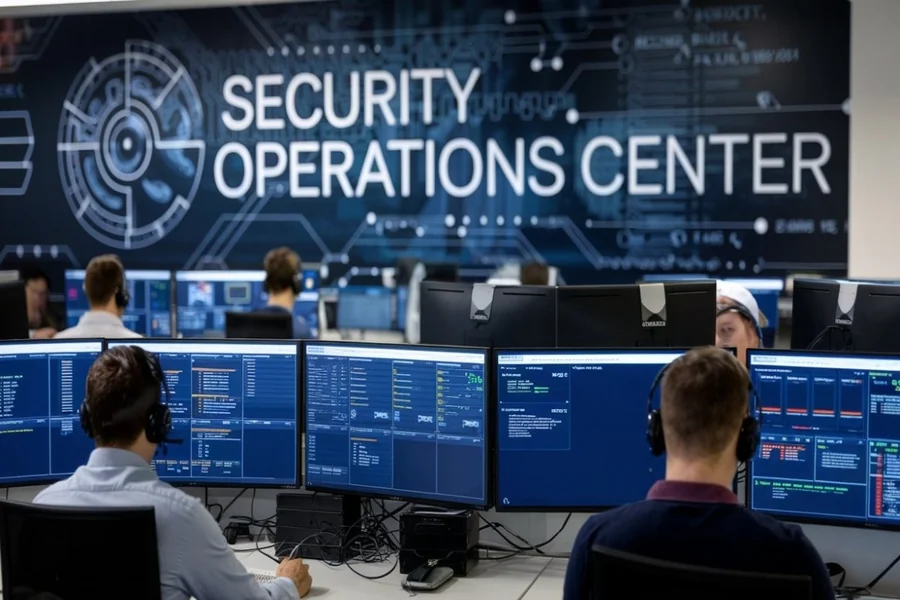
Business reality has changed for security teams, now you have a volume of alerts that no group of analysts could possibly review manually. Each connected device, application and cloud workload generates its own flow of activity, there are early signs of an actual intrusion buried in that flow. The explosion of signal from noise with the understanding that sorting through them has now become a primary challenge when operating a functioning Security Operations Center (SOC) and fundamentally reshaping how organizations think about what technology is sat in the middle of their defenses.
A security operations solution for automated response brings structure to this challenge by connecting detection, investigation, and response into a single coordinated workflow.
The Manual Triage Problem
Ten years ago it was plausible for a security analyst to attend to every alert that their firewall or intrusion detection system served up in a given shift. Now, that assumption didn’t really hold up. With cloud adoption, remote work and the exponential increase in endpoints there are millions of events that a SOC needs to process every day. When that volume is forced to be triaged manually by analysts, fatigue kicks in, false positives accrue and the important alerts are drowned out by those that do not matter.
And this is what a modern security operations platform is built to solve. Instead of calling upon a human to validate each event one-by-one, the platform uses uniform logic applied across an entire alert stream to connect related signals to risk-score them and surface only the few that most deserve scrutiny. Serious incidents are ultimately still decided from analysts, but they’re not beginning at zero on every single alert.
Automating the First Response
Detection is not enough to stop an attack. The different between detecting a threat and containing it, often referred to as dwell time, is where the real damage is done. A virus spreads for twenty minutes before someone isolates the affected device, and that ransomware infection is far more harmful than one that was caught and contained after twenty seconds.
Those gaps that you need to address and what automated response does is close that gap. If a security operations platform identifies a high-confidence threat, it can directly take previously defined containment actions like process isolation by quarantining the endpoint device, temporarily suspending the suspicious account or automatically blocking a malicious connection targeting an organizational network segment at the network layer. Instead of taking minutes/hours for a human analyst to investigate, corroborate and execute those same steps internally, these actions happen in seconds. Playbooks outline what must occur based on type of incident so that response is consistent each time rather than dependent on the analyst working.
Bringing Visibility Across the Environment
The majority of organizations run a hybrid environment consisting of on-prem infrastructure, multiple cloud providers, remote endpoints and an increasing number of Internet-connected devices. All of these environments have a tendency to produce their own logs, in their own format, usually glanced at from some different console. This fragmentation is a huge liability, as an attacker traversing an environment may leave breadcrumbs that are only visible when the disparate signals come together.
A consolidated security operations platform aggregated the telemetry from this disparate landscape into a single pane of glass. Data from network traffic, endpoint behavior, identity activity, and cloud configuration data are taken at once so the attack pattern can be seen that would not be apparent when each source is looked at individually. Having this visibility in a consolidated manner is becoming an expectation in the baseline for any organization that aims to shorten its mean time to detect and remain competitive with their mean time to respond.
Behind the Techs Supporting the People
A SOC is not only the technology. The personnel manning such a team are one of the more hi pressure jobs in IT, scanning for endless streams of potential threats, often 24 hours a day. Analyst burnout and turnover are well-known issues across the industry, and this problem is compounded the more manual and repetitive daily tasks are.
A security operations platform minimizes this burden in two ways: it helps automate some of the repetitive components of your job. For example, if you receive an alert then a well-designed security operations solution will provide the context on what was seen – it may also query one or more threat intelligence feeds to check an indicator is associated with any malicious activity and save you literally minutes drafting the first summary of an incident. This allows analysts to focus their efforts on the investigations that actually needs human judgement. Often, organizations investing in this type of automation to help retain experienced analysts while they move away from repetitive alert click-throughs to tend to more meaningful investigative work.
For incident handlers building or refining their own response procedures, established frameworks offer a useful foundation. NIST’s incident response recommendations guide outlines how organizations can align incident handling with broader cybersecurity risk management practices, and it remains a widely referenced starting point for teams formalizing their playbooks.
Choosing the Right Foundation
Not all security operations platforms are created equal, and organizations assessing their secops options should dig deep into how well a particular solution meshes with the tools they have in place, its automation proficiencies and scalability as the environment expands. Any system that requires continuous manual tuning, or that is applicable only to a section of the environment will only provide another entry point for alert fatigue rather than reducing it.
Organizations weighing whether to build a SOC internally or lean more heavily on automation and managed capabilities often benefit from reviewing how peer organizations have approached the same tradeoffs. A recent overview on structuring an internal SOC walks through how security leaders balance people, process, and technology when standing up these operations, which can be a useful reference point regardless of which path an organization ultimately chooses.
The move to automated, integrated security operations isn’t a fleeting trend. The reasoning is quite simple: attack surfaces are growing faster than your security teams, and the only sustainable way to solve that disparity is through automation that perform detection, correlation, and response at a pace no human process can match.
Frequently Asked Questions
So what does a security operations solution really automate?
It usually automates alert triage, correlates related events, and executes predefined containment steps, such as isolating an endpoint or blocking a connection. Incident analysts are still in charge of complex or ambiguous scenarios.
Why does automated response reduce dwell time?
One answer is to execute containment steps immediately after a high confidence detection– rather than waiting for a human to investigate and take action. That can reduce the response time from hours to seconds.
A security operations platform – not only usable for large enterprises
Smaller teams usually get the greatest benefit, because automation compensates for limited staffing and allows a smaller staff in a lean SOC to do more with fewer analysts.
