Introduction
The medical device industry faces immense pressure to innovate, yet traditional development processes are often lengthy and costly. A single design iteration can take months, causing companies to miss critical market opportunities and incur significant financial risks. The core issue typically lies in inefficient design validation phases. Reliance on conventional machining methods for prototype creation hinders rapid response to design changes and makes it difficult to comprehensively test product functionality and biocompatibility in real-world environments early in the process.
This article delves into how modern rapid prototyping strategies serve as a solution, enabling an agile iterative process that helps engineers identify and resolve issues during the initial development stages. The following sections will provide a detailed analysis across five key dimensions to achieve this goal.
What is Rapid Prototyping in the Medical Device Field and What is Its Core Value?
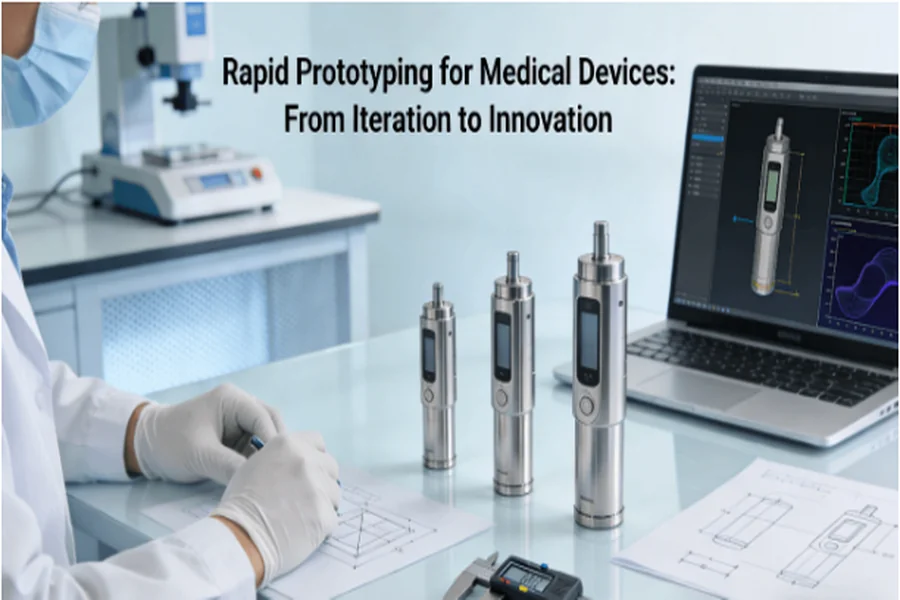
In the highly regulated medical sector, rapid prototyping meaning extends far beyond simply creating a physical model. It represents a comprehensive workflow encompassing functional testing, material validation, and compliance checks. This process leverages digital designs and advanced fabrication technologies to transform concepts into tangible parts within days, accelerating learning cycles and reducing time to market.
A Validation Process Beyond Modeling
The primary objective of medical rapid prototyping is to simulate final product performance. A prototype must closely mirror the intended mass-produced component in mechanical properties, dimensional accuracy, and, where applicable, biocompatibility. This enables rigorous functional and clinical assessment before committing to expensive tooling, de-risking the entire development process.
Core Value: Failing Fast, Learning Inexpensively
The fundamental value proposition is encapsulated by the principle of “failing fast, and iterating at low cost.” This approach systematically reduces project risk by front-loading validation.
- Accelerated Learning and Risk Mitigation
By creating and testing physical prototypes early, engineering teams can quickly uncover design flaws, assembly interferences, or usability concerns. This contains the trial-and-error cost within the inexpensive prototype phase, a stark contrast to discovering critical defects after a significant investment in production molds.
- Alignment with International Standards
This iterative validation philosophy is supported by international regulatory frameworks. Standards from bodies like the International Organization for Standardization (ISO) concerning the medical device lifecycle explicitly emphasize the critical importance of early and continuous verification, making rapid prototyping a strategically aligned practice.
A Symphony of Technologies
Achieving this efficient validation requires a synergistic combination of technologies, not a single method. Understanding how these technologies work together provides crucial Rapid Prototyping Insights. For instance, to achieve efficient rapid prototyping manufacturing, one must integrate various techniques based on specific requirements. This strategic approach ensures each prototype serves a clear verification goal, advancing Health Component Manufacturing toward success.
How to Choose the Most Suitable Rapid Prototyping Technology for Different Medical Components?
Selecting the correct technology is an art of balancing precision, material properties, timeline, and budget. A rapid prototype for a delicate surgical instrument handle has different requirements than one for a bone implant or a housing for an in-vitro diagnostic device.
Technologies like 3D printing excel at producing complex internal geometries or organic shapes, ideal for anatomical models. CNC machining is preferred for metal implants or tools requiring micron-level tolerances and superior surface finish from medical-grade materials. For small-batch production of plastic parts, vacuum casting can economically replicate dozens of units with production-like quality. A clear decision flowchart should guide the selection based on precision needs, material biocompatibility, budget, and schedule. In medical applications, Precision Manufacturing and material integrity often outweigh the absolute lowest cost. The relationship between CNC prototyping cost and final part quality is critical; a reliable prototype provides invaluable data, justifying the investment. Effective Custom Part Solutions depend on this careful technological alignment.
How Does Precision Rapid Prototyping Meet the Stringent Quality Assurance Standards of the Medical Industry?
The prototyping phase is not exempt from quality management; it is its foundation. Adherence to Quality Assurance Standards is paramount. A robust quality control process must be integrated from the digital model to the final part, including first-article inspection, in-process parameter monitoring, and final dimensional verification.
Selecting a supplier with a certified Quality Management System (QMS), such as ISO 13485 (for medical devices) and ISO 9001, is crucial. These certifications ensure process traceability and consistency. For example, a supplier like JS Precision demonstrates its commitment to continuous improvement through such international certifications. The U.S. Food and Drug Administration’s (FDA) Quality System Regulation provides a authoritative framework for the entire device lifecycle. Therefore, Precision Manufacturing in prototyping is fundamentally about establishing and executing a reliable, auditable quality process.
What Key Factors Should Be Considered When Obtaining an Accurate Rapid Prototyping Service Quote?
Requesting a rapid prototyping service quote from a custom prototype manufacturer necessitates providing clear and detailed information for accuracy. A transparent quotation is typically based on several key factors.
Core Variables Influencing Quotation
Obtaining an accurate rapid prototyping service quote hinges on several transparent factors. The final cost is directly driven by a combination of project specifications and preparatory choices.
- Design Complexity & File Quality
The geometric intricacy of the part is a primary cost driver. Complex features, deep cavities, or thin walls increase programming and machining time. Additionally, providing a clean, error-free 3D CAD file (e.g., STEP format) reduces engineer preparation time, contributing to a more efficient quote.
- Technology, Material & Post-Processing
The selected manufacturing technology and material grade fundamentally determine the base price. Furthermore, medical prototypes often require specialized post-processing like sterile cleaning or application of biocompatible coatings, each adding cost and time to the project.
Optimizing Design for Cost Control
Intelligent design optimization is key to managing expenses. Proactively simplifying non-critical geometries and incorporating features like draft angles can significantly reduce manufacturing difficulty. These Design for Manufacturability (DFM) principles facilitate smoother production, leading to a more competitive quotation from a custom prototype manufacturer.
Best Practices for Efficient Quoting
Providing a complete information package—including 3D files, 2D drawings, material specs, and quantity—enables a precise quotation. Many professional suppliers offer online tools for instant estimates. For instance, exploring rapid prototyping services with integrated quoting tools can significantly enhance efficiency during the initial inquiry phase.
What Best Practices Are Demonstrated by Successful Medical Device Rapid Prototyping Cases?
A hypothetical yet logical case study illustrates the value of strategic rapid prototyping. A company developing a new portable insulin pump, a project focused on Lifestyle Product Engineering, needed to validate ergonomics and internal fluidic seal reliability quickly.
The team collaborated with a precision manufacturing partner to iterate three functional prototype versions in two weeks. The first version (3D printed) assessed basic form and fit. The second (CNC machined from medical-grade plastic) tested ergonomics and internal structure. The final version (CNC machined with sealing components) underwent rigorous pressure cycling tests. This agile “design-build-test” cycle resolved core issues before tooling, slashing the validation timeline by 60%. Success hinged on cross-functional collaboration, clear testing goals for each iteration, and selecting a capable partner.
Conclusion
In summary, integrating strategic rapid prototyping into the medical device development workflow is proven to accelerate innovation, control risk, and ensure final products meet stringent Quality Assurance Standards. It transcends being a mere technical tool, becoming a core business strategy that reduces overall product development risk.
Is your next medical device innovation ready for acceleration? Contact a rapid prototyping service provider with extensive medical industry experience and a robust quality system to receive a detailed project-specific proposal and quotation. Take the first step towards efficient and reliable research and development.
Author Biography
This article was written by a precision manufacturing expert with over a decade of experience, specializing in the application of advanced manufacturing technologies in the medical and tech industries. The author is dedicated to helping companies achieve a dual leap in efficiency and quality during product development.
FAQ Section
Q1: What are the commonly used medical-grade materials for rapid prototyping?
A: Common materials include medical-grade stainless steel 316L, titanium alloy Ti6Al4V, biocompatible ABS, PC, and high-performance plastics like PEEK. These materials must comply with relevant biocompatibility standards to ensure safety upon human contact.
Q2: What should be considered during the transition from prototype to mass production?
A: The key is controlling design changes between the prototype and production parts. It is crucial to ensure the validated prototype design can be seamlessly translated into mass production processes, and conducting a Design for Manufacturability analysis beforehand is essential to avoid major issues.
Q3: What is the typical lead time for rapid prototyping?
A: Lead time depends on the technology, complexity, and quantity. Simple plastic parts may take 1-3 days, while high-precision metal functional prototypes might require 5-10 business days. Clear communication with the supplier is vital for on-time delivery.
Q4: How is intellectual property protected during the prototyping process?
A: Choosing a reputable supplier is critical. Partners who offer strict Non-Disclosure Agreements, and hold information security management system certifications like ISO 27001, are essential for safeguarding design files and data.
Q5: Besides appearance and dimensions, what other tests can be performed on medical device prototypes?
A: Functional prototypes can undergo various tests, including mechanical performance, fluid dynamics, electrical safety, and basic usability validation, providing valuable data for comprehensive assessment.