Introduction
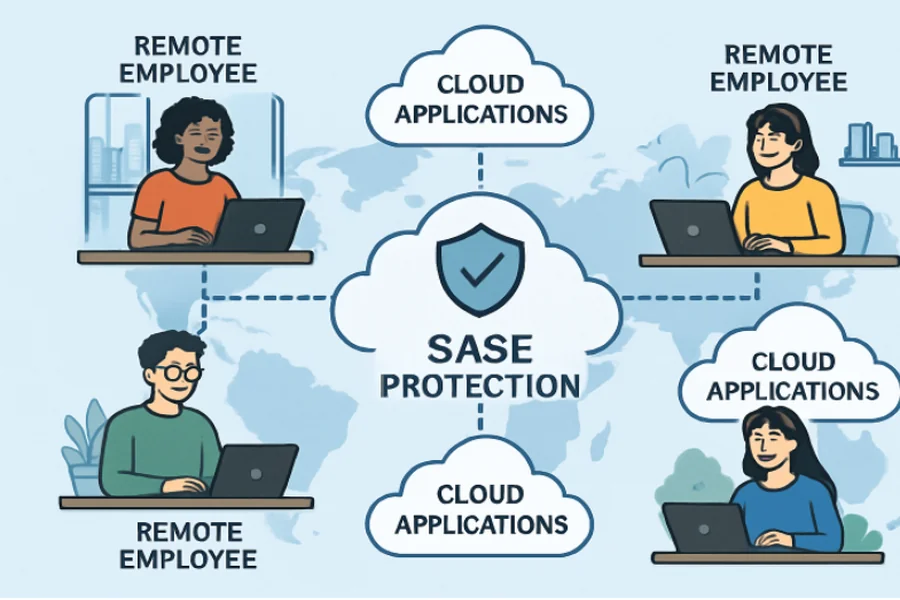
The surge in remote work has fundamentally shifted how organizations operate, forcing business and IT leaders to reconsider not only the logistics of a distributed workforce but also how critical business resources and sensitive data are secured and delivered. In the era of cloud computing and flexible work arrangements, conventional perimeter-based security models—where defenses are often focused on the physical office—are proving inadequate for today’s reality. Employees, contractors, and partners now use a mix of corporate and personal devices from countless locations around the globe, which means the risk landscape is expanding rapidly.
Organizations now face complex challenges: ensuring secure access to corporate applications, monitoring increasingly diverse endpoints, and empowering teams to work efficiently regardless of their location. This pressing need for change has propelled SASE (Secure Access Service Edge) to the forefront. By offering a unified, cloud-native platform that integrates robust security controls with agile, high-performance connectivity, SASE represents a new architectural approach to networking. It equips businesses with much-needed flexibility, while also strengthening the protection of confidential data and mission-critical systems.
As the workplace continues to evolve, with many organizations opting for hybrid or fully remote models, SASE stands out as a future-ready solution. It empowers IT administrators to maintain centralized control while providing remote users with fast and secure access to the tools they rely on.
Understanding SASE
SASE is best described as the convergence of network connectivity and advanced security services, all offered as an integrated, cloud-delivered solution. As explained in NetworkWorld, unlike legacy models that deploy standalone products for virtual private network (VPN) access, firewalls, or web security, SASE unifies essential capabilities such as Zero Trust Network Access (ZTNA), Secure Web Gateway (SWG), Cloud Access Security Broker (CASB), and Firewall as a Service (FWaaS) into a cohesive platform. This means that users connect—regardless of device or location—through a single security and network stack designed for the cloud age.
This convergence brings several key advantages. Policy enforcement, for instance, becomes far more consistent as controls are set and managed centrally and pushed out to all users and branches through the cloud. By eliminating a patchwork of separated tools, SASE also removes blind spots and simplifies monitoring, compliance, and threat response. Importantly, it eliminates traditional network bottlenecks, as data is routed through optimized points of presence closer to users, accelerating access to cloud applications for globally distributed teams and ensuring that IT operations are both streamlined and robustly protected against modern cyber threats.
Drivers of SASE Adoption
Several powerful trends and challenges are fueling the rapid adoption of SASE solutions across industries and sectors, especially as more organizations embrace permanent remote and hybrid workforces:
- Security Concerns: With employees working from home, in public spaces, or while travelling, the attack surface that organizations must defend has grown exponentially. Legacy VPNs and network-centric security approaches often fall short of detecting sophisticated phishing, ransomware, or account takeover strategies. According to recent research, a staggering 99% of businesses reported a cybersecurity incident last year, with almost half directly tied to remote access and hybrid work models. The urgency to close security gaps and reduce risk is a pivotal reason organizations are embracing SASE, especially in light of evolving threats like the litellm supply chain attack that highlight vulnerabilities in modern software ecosystems.
- Performance Issues: Traditional VPNs often force traffic back through a central data center, introducing lag, bandwidth congestion, and unpredictable connection quality for remote workers. As more teams rely on cloud services such as email, collaboration suites, or video conferencing, poor performance directly impacts productivity and employee satisfaction. SASE resolves this by routing data traffic through a global network of cloud points of presence, ensuring quick and reliable application access, regardless of users’ locations.
- Cost Efficiency: Maintaining a fragmented set of networking and security tools increases operating expenses and burdens IT with repetitive management. Juggling multiple vendors, contracts, and integration points can lead to costly errors and reduce the overall return on investment. SASE’s unified, subscription-based service model consolidates functions into a single platform, reducing overhead and driving both immediate and long-term operational savings.
Benefits of SASE for Remote Work
Moving to a SASE-powered environment delivers tangible advantages for organizations striving to secure and empower a remote-first workforce:
- Enhanced Security: At the core of SASE is a zero-trust mindset, where every user, device, and connection is authenticated and continuously validated, regardless of the user’s location. SASE leverages multi-layered security policies that are updated in real-time, ensuring remote employees remain protected from evolving threats. As highlighted in CIO’s discussion on why SASE sits at the centre of a hybrid workforce, this comprehensive and adaptive approach significantly reduces the risk of breaches, data leaks, and unauthorized access, particularly in high-stakes or highly regulated industries.
- Improved Performance: SASE’s architecture is built on a global backbone of distributed cloud points of presence. This enables application traffic to be routed via the shortest and most efficient path, thereby reducing latency and enhancing the user experience when accessing critical cloud services. Employees, regardless of their location, enjoy fast and dependable connectivity for both daily tasks and high-bandwidth applications, such as video conferencing or real-time collaboration.
- Scalability: As business needs shift—whether during rapid periods of growth, global expansion, or downsizing—SASE solutions stand out for their agility and scalability. Cloud-native by design, SASE allows organizations to scale up or down rapidly, customizing deployment without the need for costly new hardware or lengthy lead times. Whether supporting hundreds or tens of thousands of users, the platform adapts effortlessly.
Supporting a Remote, Distributed Future
By merging multiple networking and security capabilities into a unified cloud service, SASE provides IT teams with unmatched visibility and control, without compromising business agility. This integration proves vital as compliance requirements tighten and cyber threats become increasingly sophisticated. Ultimately, SASE enables organizations to provide remote employees with the flexibility they crave, while ensuring administrators maintain oversight and can swiftly respond to new risks.
Implementation Considerations
While SASE offers significant advantages, successful deployment requires a strategic plan and careful management:
- Assessment of Current Infrastructure: Begin by thoroughly auditing the current networking and security environments, including all legacy hardware, current security stacks, bandwidth capacity, and application architectures. This groundwork helps organizations pinpoint integration challenges and develop a roadmap that minimizes disruption. It may also reveal opportunities for consolidation or remediation of technical debt during the transition.
- Vendor Selection: Choosing a SASE partner is more than a technical decision; it’s a long-term relationship. Beyond evaluating the core technical capabilities, seek vendors with a proven track record of support, robust service-level guarantees, and the ability to integrate with your organization’s existing ecosystem. Strong reporting, compliance management, and analytics are crucial for ongoing governance as needs evolve.
- Change Management: Rolling out SASE affects both IT staff and end users. Organizations must invest in comprehensive training and clear communication regarding new policies and expected behaviors. Providing documentation, hands-on onboarding, and responsive help desk support ensures a smooth adoption process, while feedback mechanisms enable IT to respond to roadblocks or concerns as they arise.
Phased Approach: Maximizing SASE ROI
For many businesses, a phased rollout is the most effective strategy. Start by targeting high-risk groups or mission-critical business units, establishing early wins, and refining processes based on real-world experience. Measure the impacts on security, performance, and user satisfaction, then expand deployment to the broader organization. This iterative approach enables leaders to adjust their strategy, avoid pitfalls, and maximize long-term returns.
Conclusion
As remote and hybrid work arrangements become a permanent fixture, Secure Access Service Edge (SASE) emerges as a transformative solution, aligning security and network agility with the realities of modern business. By uniting advanced connectivity and adaptive security in a single, scalable cloud framework, SASE enables organizations to strike a balance between productivity, protection, and cost efficiency—regardless of their teams’ locations.